Линейка решений GenericX
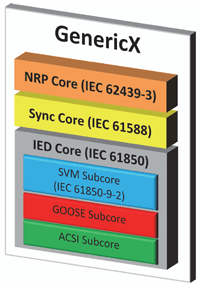
GenericX comprehensive software-hardware solutions for creating intelligent electronic devices (IED) for the “Digital Substation”. The solutions include support for the complete list of information protocols and service mechanisms of the “Digital Substation”.
GenericX serves as a technological foundation enabling the development of IED devices for various functional purposes.
GenericX significantly reduces development timelines, guarantees information compatibility of devices, and ensures compliance of solutions with international requirements and standards. The proposed approach involves separating the GenericX software-hardware block and the block of applied algorithmic software (software-hardware or software-only). Information exchange for the applied algorithmic part of devices is carried out through GenericX elements, which ensure the operation of corresponding information protocols, compliance with data transmission and processing regulations, correct data interpretation, and support for the necessary level of protocol implementation variability required for information compatibility. GenericX allows the user to focus on implementing algorithms and functional content of devices without expending resources on the labor-intensive implementation of digital substation information protocols.
Software-hardware implementation of “Digital Substation” protocols ensures high operational performance and does not require allocation of computational and communication resources from the application core. In particular, the synthesis of software and hardware components provides high precision synchronization via the PTP protocol (IEC 61588), reliability and independence of operation of redundant communication interfaces (PRP/HSR protocols, IEC 62439-3), reduced load on the application core when processing streaming data (including IEC 61850-9-2), information stability under high communication loads (including GOOSE storms), etc.
The foundation of the GenericX solutions is based on the results of the company’s long-term work in developing intelligent electronic devices (IED), its own implementation stack of information protocols, and original software-hardware solutions.
GenericX Components
GenericX includes three basic components*:
- NRP Core – software-hardware implementation of communication environment redundancy protocols PRP/HSR (IEC 62439-3). The component enables transparent integration into a high-availability communication network;
- Sync Core – software-hardware implementation of calendar and instrumental synchronization. The component includes the software-hardware implementation of the high-precision time synchronization protocol PTP (standard IEC 61588, IEEE 1588 Ed 2.0);
- IED Core – software-hardware implementation of protocols and service mechanisms of the IEC 61850 protocol, which serves as the information-communication foundation of the “Digital Substation”.
* – each component is autonomous and can be used independently.
IED (Intelligent Electronic Device) Core
IED Core – the foundational part of GenericX, implementing support for the IEC 61850 protocol group. The software-hardware implementation of the protocols achieves the following effects:
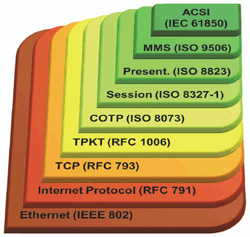
1. Software Independence. The client-server part of IEC 61850-8-1 is one of the most complex sections of the standard to implement, as it involves a large number of encapsulated protocols and significant variability in the implementation of each. The proven software-hardware implementation of IEC 61850-8-1, included in the IED Core, allows the device’s applied algorithmic core to be made independent of the variations in information protocol implementation. This greatly simplifies its development, makes the behavior of the IED device significantly more deterministic, and enhances information compatibility between devices.
2. Responsiveness. IED Core includes support for the mechanisms of receiving and transmitting GOOSE messages, which are among the most communication-unpredictable elements of the “Digital Substation”. IED Core allows, on one hand, to shield the main core of the IED from external GOOSE messages (addressed to other devices, duplicate messages, etc.), and on the other hand, simplifies the process of sending its own GOOSE messages by relieving the applied algorithmic core from the tasks of regularly processing periodic messages, generating sporadic sequences, etc.
3. Performance. IED Core supports the IEC 61850-9-2 protocol (reception). This protocol is characterized by the highest volume of communication activity in the “Digital Substation”. The volume of transmitted information is quite significant and requires substantial computational resources for its processing and filtering. IED Core provides preliminary processing of incoming information, including data filtering, autonomous processing of optional fields, quality flags, monitoring instantaneous values against user settings, and calculation of basic electrical quantities based on user configuration (e.g., RMS over a period).
Sync Core
Sync Core is a component that provides calendar and instrumental synchronization for the created IED device and includes software-hardware implementation of 1PPS, IRIG-B interfaces and the PTP protocol (IEC 61588, IEEE 1588 Ed. 2.0).
NRP (Network Redundancy Protocol) Core
The primary method of increasing the reliability of the “Digital Substation” (DSS) communication network is its redundancy, implemented using specialized protocols for high-availability networks: PRP – Parallel Redundancy Protocol, or HSR – High-availability Seamless Redundancy protocol (IEC 62439-3). NRP Core contains the software-hardware implementation of both protocols. Redundancy protocols involve a significant volume of service communication traffic, as well as a large amount of duplicated information (in fact, an IED device in a PRP/HSR network experiences doubled communication load). NRP Core includes support for the service communication exchange required by the protocols, filtering of duplicated information, while ensuring the required performance indicators, freeing computational resources of the applied algorithmic core, and minimizing the processing time of communication packets.
Generic Card
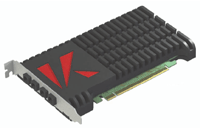
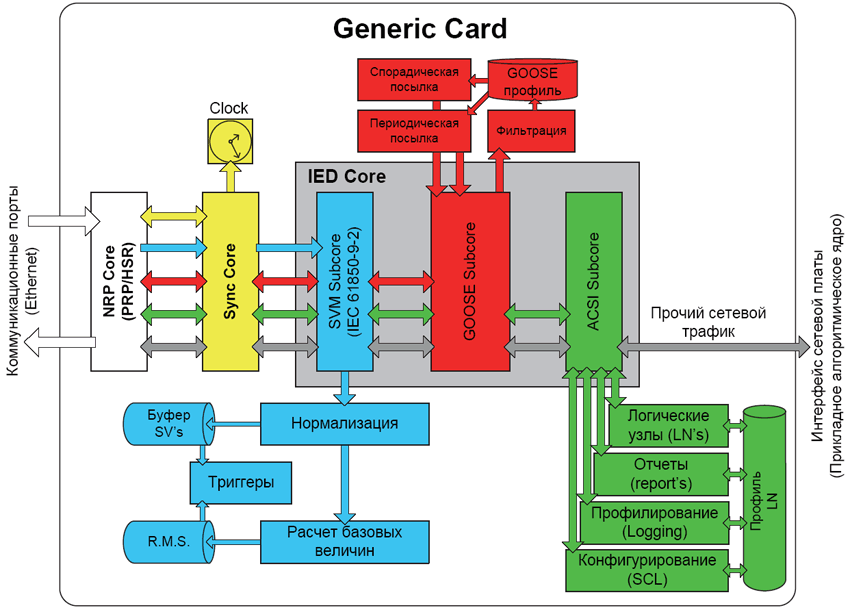
Generic Card – the software-hardware implementation of the GeneriсX solutions, executed in the PCI-express expansion card form factor and intended for installation in an IBM PC compatible computer running the Linux operating system. The Generic Card model range includes expansion cards with various synchronization interfaces, including hardware support for PTP, different quantities and sets of communication interfaces, and support for communication network redundancy technologies.
Additionally, the Generic Card implements network adapter functions, allowing the user to organize information exchange via other protocols (target traffic is intercepted and processed by the card but can also be made available to the applied algorithmic core; non-target traffic is passed through without processing).
The embedded solution kit includes a set of software libraries (API) and a development toolkit (SDK).
The embedded solution Generic Card provides:
- simplicity in developing the applied algorithmic core;
- the ability to use an IBM PC compatible computer as a software-hardware platform for running applied algorithmic software;
- ease of scaling the performance of the applied algorithmic core and the capacity of permanent and non-volatile memory;
- the possibility of integration with third-party software.
Generic IED
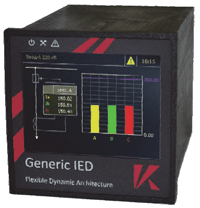
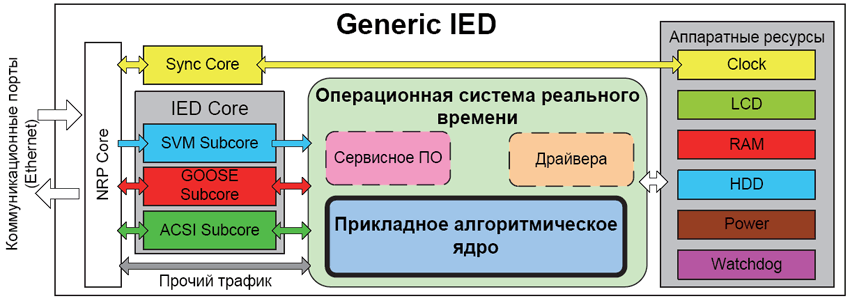
Generic IED – the software-hardware implementation of the GeneriсX solutions, executed in the electronic unit form factor. Generic IED is a complete comprehensive solution for creating custom IED devices. The device is equipped with the necessary set of communication interfaces, two power supply interfaces (redundant AC/DC input), and a color touch screen. The hardware form factor allows for panel mounting (ANSI 6”).
The hardware design ensures climatic and mechanical resilience, EMC (IEC 61850-3). The hardware solution architecture is scalable – it allows for increasing the performance of the computational core, equivalent FPGA capacity, and the amount of RAM and permanent (non-volatile) memory. Generic IED can be equipped with various types of communication interfaces (connector types, data transmission media) and supports Ethernet interfaces up to 1 Gbps.
The hardware implementation includes a real-time operating system, under which the following software operates:
- service software ensuring support for digital substation communication protocols and information mechanisms;
- hardware drivers;
- applied algorithmic core.
The applied algorithmic core provides interfaces for working with service software (digital substation communication protocols) and hardware resources. The service software also performs functions of hardware self-diagnostics, file management, embedded firmware updates, information security procedures, and software execution integrity control (watchdog).
Access to the hardware part is achieved through hardware platform drivers and allows the user to create a custom human-machine interface (HMI) tailored to functional tasks, organize long-term or operational data storage, access calendar time, control power supply, etc.
Generic IED includes an environment for developing the applied algorithmic core and an SDK for integrating user software into the hardware platform.
Generic IED is a ready-made software-hardware solution that meets the requirements of the “Digital Substation”.
This option allows for developing IED devices with required functionality within limited timeframes and creating IED devices tailored to specific customer requirements.
Communication Solutions for High-Availability Networks (HSR/PRP)
A key issue in building a “Digital Substation” is the reliability of the communication network, as a failure of this single element can lead to the inoperability of the entire substation control system.
The existing solution to this problem is the use of high-availability communication networks – the application of the Parallel Redundancy Protocol PRP or the High-availability Seamless Redundancy Protocol HSR (IEC 62439-3). Devices operating with these protocols must support a specific set of service protocol functions and have sufficiently high communication performance.
Support for these protocols by equipment manufacturers will require a certain amount of time, related to increasing the communication performance of devices and implementing the protocols themselves. It should be noted that the protocols possess a certain complexity and require significant computational and communication performance from devices, leading to the necessity of developing new devices (implementing these protocols based on existing devices does not seem feasible). Transitioning to networks with redundancy will require significant modernization of currently available solutions for the “Digital Substation”.
Device without HSR/PRP Support
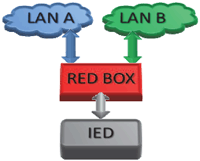
In addition to the mentioned technical complexities, there is the question of economic feasibility – for many types of devices, support for redundancy protocols is inherently excessive. In this regard, the task arises of ensuring communication connectivity between devices that support redundancy protocols and those that do not.
To solve this task, the IEC 62439 standard provides for the use of specialized communication adapters (Red Box) that perform the service functions of the protocol, parse duplicated packets, and translate the filtered data to a device that does not support these protocols (SAN – Single Attached Node).
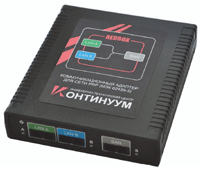
The communication adapter for high-availability networks with parallel redundancy (PRP) uses the NRP core of GenericX. This device is designed to connect equipment equipped with an Ethernet interface to a network with parallel redundancy (PRP, IEC 62439-3).
The communication adapter can be equipped with various types of communication interfaces (copper/fiber optics, a wide range of connector types), including an option combining the functions of the device with a media converter for cases where the transmission medium in the redundant network and the communication interface of the device differ.
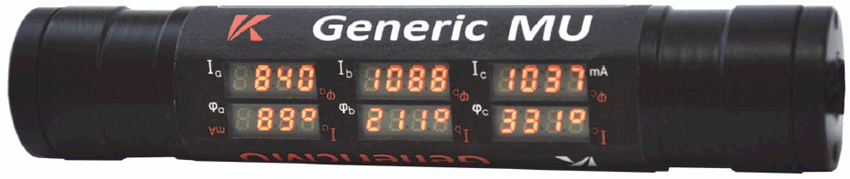
Compact Digital Converters Generic MU
The field level of the “Digital Substation” includes intelligent primary electrical equipment (e.g., electronic instrument transformers) or traditional primary equipment equipped with field converters (Stand Alone Merging Units).
Field converters allow integrating existing high-voltage equipment with analog and discrete interfaces into the process bus of the “Digital Substation”, enabling a gradual transition to “digital” circuits. Using field converters achieves most of the technical and economic effects associated with implementing the field level of the “Digital Substation”, without requiring replacement of expensive high-voltage equipment. Options for combining “digital” and “analog” buses are possible (one part of the substation operates according to the traditional scheme, while another part operates within the “Digital Substation” approach).
Experience in implementing field converters has shown that placing large-sized field converters in an outdoor switchgear (OSD) of a substation is quite challenging. On the other hand, installing field converters at a substation does not eliminate the need for current circuit and voltage circuit cabinets (terminal assembly cabinets).
Based on this experience, ITC Continuum specialists have developed a line of compact field converters that allow placement in limited space (e.g., in existing terminal assembly cabinets). The devices support the IEC 61850-9-2 protocol, including edition 2.0 and specification 9-2LE, client-server interaction via the IEC 61850-8-1 protocol, and a wide range of service protocols to support operational processes.
The device housing provides high mechanical strength, and the use of specialized components and additional technical solutions enables broad climatic characteristics of the device, allowing its use without additional heating in most parts of the Russian Federation.
Technical solutions applied in the development of embedded field converters allow for break-free connection to secondary circuits, with measurement sensors combined with remote ADC modules. For current circuits, measurement modules with a separable sensor are used, enabling connection without compromising the integrity of secondary circuits, thus without increasing the risk of their breakage and reducing secondary circuit reliability associated with the use of additional transitional terminal assemblies. For voltage circuits, piercing-type modules or direct terminal connection are provided. These technical solutions significantly reduce the size of the field converter, simplify installation work, and enhance the reliability and fault tolerance of the electronics.
The line of embedded field converters includes: for current circuits (measuring and protection), for voltage circuits, combined devices, devices with discrete inputs and outputs, as well as devices designed for controlling switching equipment, monitoring power transformers, etc.