
Development of Synchronized Phasor Measurement Units (Journal ENERGOEXPERT No. 5 — 2011)
Journal ENERGOEXPERT No. 5 - 2011
Authors:
- Popov S.G., Head of the Experimental Test Site “Digital Substation”, JSC “Electric Power Research Center”, Ph.D. (Engineering)
- Balabin M.A., Head of the New Technologies Department, Branch of JSC “Electric Power Research Center” – SibNIIE
- Narovlyansky V.G., Head of Department, JSC “Energosetproekt”, Dr.Sc. (Engineering)
- Vaganov A.B., Leading Research Associate, JSC “Energosetproekt”, Ph.D. (Physics and Mathematics)
- Peregudov S.A., General Director of JSC “ITC Continuum”
- Kirillov A.S., Head of Department, JSC “ITC Continuum”
- Kuzmin A.A., Project Manager, JSC “ITC Continuum”
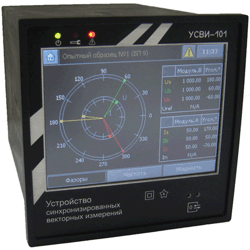
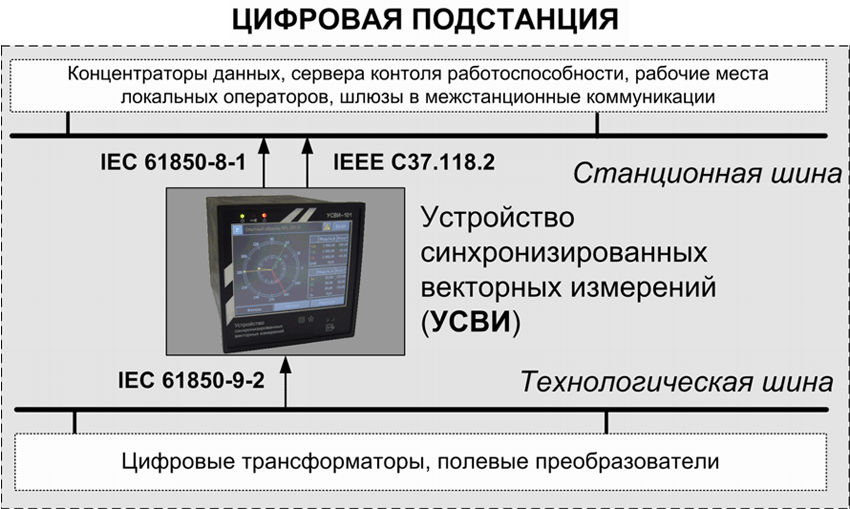
The IEC 61850-9-2 protocol is characterized by high information capacity (12,800 instantaneous value samples per second), and IEC 61850-8-1 by the complexity of encoding/decoding frames according to ASN.1 BER rules. Therefore, a new-generation SPMS must possess significant performance in its communication subsystem and computational core.
It is worth noting the high scientific intensity of the metrological algorithm development process, associated with the specific feature of transmitting instantaneous current and voltage samples in the IEC 61850-9-2 format (fixed sampling rate in time and level). This specific feature, in particular, does not allow the use of well-established metrological mechanisms such as phase-locked loops (PLL). At the same time, the new version of the IEEE C37.118 standard imposes significantly stricter requirements on measurement accuracy and speed, and also standardizes measurements during transient processes. The hardware and software parts of the new-generation SPMS were developed considering the latest trends in the development of electric power automation systems. In particular, power supply redundancy is provided (simultaneous use of AC and DC sources is allowed), as well as redundancy of Ethernet communication interfaces. The device is built on a modular principle, which ensures flexibility in forming the device configuration (it can be equipped with additional discrete input/output modules, analog input modules of various specifications). Despite the possibility of the SPMS operating from the process bus, the ability to work with traditional current and voltage instrument transformers is also ensured (presence of analog inputs for current 1A and 5A and for voltage 57.7V and 100V). The presence of analog inputs in the device allows integrating it into substations equipped with traditional current and voltage transformers.Based on the need for high computational performance of the device, a unique multi-processor platform with specialized communication and computational blocks was developed for it. Interaction between system components is ensured by using a high-speed parallel data bus with a throughput of up to 3.2 Gbps.
Significant attention was also paid to the human-machine interface – the device is equipped with a touch color display and an internal WEB server. Another important aspect of the device’s operation is its reliability, largely determined by its embedded software. In this regard, special attention during the development of the SPMS was paid to device performance (the delay in delivering results is strictly regulated by the new version of the IEEE C37.118 standard). Compliance with regulatory requirements was only possible through the use of a hard real-time operating system. An additional effect of using such an OS was an increase in the device’s information security – launching third-party software and running any malicious software on this platform is impossible.In addition to performing its main function (measuring and transmitting synchronized phasor measurements in the IEEE C37.118 protocol format), the device:
- is equipped with means for its integration into information systems through protocols IEC 61850-8-1, IEC 60870-5-104, FTP, HTTP, TELNET, SNMP;
- performs calculations of additional (besides current/voltage phasors, frequency and rate of change of frequency regulated by IEEE C37.118) electrical parameters – active, reactive, apparent power and power factor on each period of the nominal network frequency phase-wise and total for all three phases, RMS values of currents and voltages.