
Gateway-Logger ShR-ASDU
Contents:
Purpose
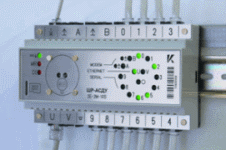
The ShR-ASDU gateway-logger is designed for creating a comprehensive system for commercial and technical electricity metering (AMR/AMM) and dispatch control systems of energy facilities (SCADA).
The main objects of ShR-ASDU implementation are 6-10 kV switchgear. The devices ensure minimization of costs for the creation, operation, and modernization of the created automated system.
General Device Description
The ShR-ASDU gateway-logger is a specialized multiport device, supporting up to 10 RS-485 ports, up to 2 Ethernet ports, and up to 2 RS-232 ports.
Ethernet ports and RS-232 ports are intended for establishing communication with upper-level devices (AMR system servers, telemechanics servers, SCADA servers, etc.). RS-232 ports are used for connecting to GSM/GPRS modems or other end devices (e.g., relay protection and automation devices – РЗА). The ports are communication-independent and can operate within different data transmission networks.
RS-485 ports are intended for connecting electricity meters and interface modules providing telemechanics functions. The ports are independent and allow for parallel polling of electricity meters and interface modules. Each RS-485 port can operate in one of the following modes:
ASDU – this port performs cyclic polling of electricity meters for electrical parameter measurements (current, voltage, power, frequency, etc.).
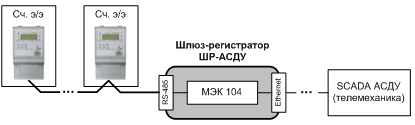
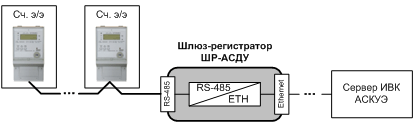
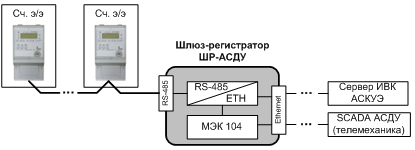
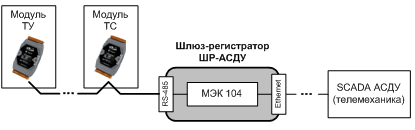
The port operation mode is a configurable parameter and can be changed during operation. Telemetry data obtained from electricity meters and telemechanics data from interface modules are accessible via the GOST R IEC 60870-5-104 protocol.
ShR-ASDU Functional Diagram
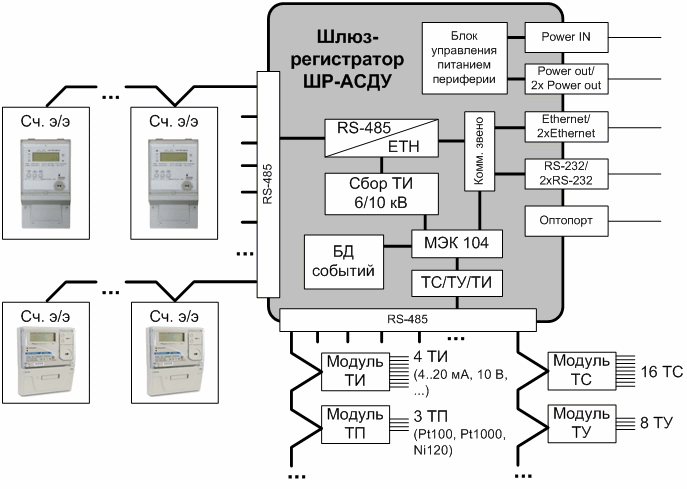
Interaction with AMR
ShR-ASDU provides organization of a “transparent” data transmission channel for RS-485 ports operating in AMR and AMR/ASDU modes (for the AMR system server, the device’s behavior is similar to a standard media converter). In AMR/ASDU mode, information interaction with the AMR system has higher priority compared to the cyclic collection of ASDU telemetry.
Within the AMR framework, ShR-ASDU serves as channel-forming equipment, as it does not perform intermediate data processing, collection and storage of accumulated electricity profiles and logs from electricity meters, or synchronization of the internal clocks of meters. The device does not require metrological certification, periodic calibration, or inclusion in the type description of the upper-level AMR system.
ShR-ASDU enables the organization of a “transparent” data transmission channel for the purposes of configuring electricity meters, diagnostics, and collecting additional data.
Interaction with Telemechanics System (SCADA)
The data collected from electricity meters and interface modules are processed by the internal IEC 104 software module, which implements support for the GOST R IEC 60870-5-104 protocol. Within the framework of supporting the GOST R IEC 60870-5-104 protocol, communication mechanisms such as general interrogation, parameter read/write, cyclic transmission, and spontaneous transmission (based on setpoint or aperture) are implemented. The volume of transmitted data, transmission cyclicity, as well as individual setpoint and aperture values are configurable parameters and available for user modification.
The ShR-ASDU gateway-logger supports the data transmission protocol of electricity meters of the SET/PSCh type to the extent necessary for reading telemetry data, power quality indicators (PQI), and the fault log.
Recording Functions
The ShR-ASDU gateway-logger maintains event logs and forms a telemetry database. This data is accessible via communication interfaces and allows for the reconstruction of the situation history at the energy facility even in the event of communication medium failure.
Description of External Interfaces
RS-485 Interfaces
Depending on the model, ShR-ASDU is equipped with either 4 or 10 full-duplex RS-485/RS-422 ports. Each port can be individually configured: baud rate from 9,600 to 115,200 bps (bits/sec), configurable connection parameters (parity, stop bits, etc.). RS-485 ports are implemented based on standard RJ-11 (6p6c) connectors.
Ethernet Interfaces
ShR-ASDU is equipped with one or two 100 Mbps Ethernet ports (100BASE-TX) providing connection to an Ethernet network. Models equipped with two Ethernet ports can operate in one of the following modes:
- Independent Ethernet – each device port can be connected to its own Ethernet network (for example, one to the AMR network with its own IP addressing, and the second to the SCADA network with different IP addressing). In this mode, the ports are communication-isolated. The presence of two independent Ethernet interfaces allows for the separation of operational zones between different departments operating this energy facility.
- Redundancy – one of the Ethernet ports is primary, the other is backup.
- Switch – the device additionally acts as a two-port switch, allowing, besides the device itself, the connection of an additional Ethernet device.
RS-232 Interfaces
Some ShR-ASDU models are equipped with two RS-232 ports intended for connecting to GSM/GPRS modems or other end devices.
The device provides support for the full set of AT commands and services necessary for establishing a PPP connection over GPRS. Models equipped with two RS-232 ports ensure communication channel redundancy.
Additionally, each RS-232 port is equipped with a specialized 12 V power output designed for powering a GSM/GPRS modem. ShR-ASDU monitors the operational status of the GSM/GPRS modem and, if technically necessary, performs a forced restart of a “frozen” GSM/GPRS modem by briefly disconnecting its power supply. RS-232 ports can also be used to connect other devices, such as relay protection and automation devices (support for data protocols of these devices is provided upon additional request).
Optical Port
ShR-ASDU is equipped with a configuration port for connecting an optical head. This interface is for configuration purposes and allows configuring devices without disconnecting/connecting detachable interfaces. The interface is compatible with the requirements of the IEC 61107 standard, which allows using the same optical head for configuring both ShR-ASDU and electricity meters.
Information Services
In addition to its core functionality, ShR-ASDU supports additional services that ensure ease of operation and the possibility of expanding its functional application.
Device configuration can be performed through external interfaces (Ethernet, RS-232) or via the optical port. For configuration purposes, ShR-ASDU supports the telnet command interface. Furthermore, the device contains a built-in WEB server (HTTP) that allows convenient configuration of main parameters and device diagnostics through a web browser. The WEB server is accessible via Ethernet ports or via RS-232 when operating in PPP mode over GPRS.
Synchronization of ShR-ASDU’s internal clock is performed via the NTP protocol. The internal clock readings are used for correct maintenance of the device’s event log.
The SNMP protocol provides the ability to integrate ShR-ASDU into automated system diagnostic systems.
ShR-ASDU Technical Specifications
| Mechanical Characteristics | |
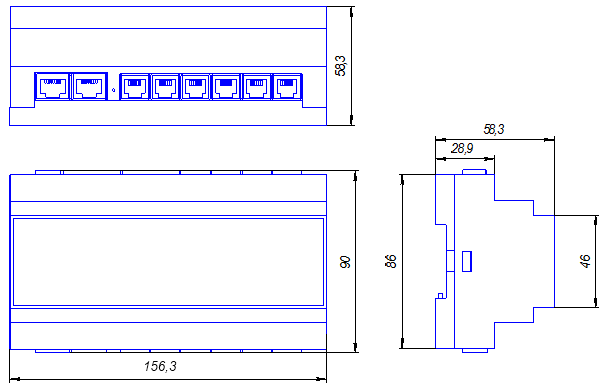
| Dimensions, mm | 156 x 58 x 90 (W x H x D) |
| Weight, kg | up to 0.8 |
| Mounting method | DIN rail (TH/35-7.5; TH/35-15) |
| IP class | IP20 |
| Operating Conditions | |
| Operating range | 0 °C … +45 °C, <90% without condensation (commercial version) -25 °C … +45 °C, <90% without condensation (industrial version) |
| Storage range | -45 °C … +45 °C, <90% without condensation |
| Power Supply | |
| Power supply range, V | 12 V DC, allowable range 8..20 V |
| Power consumption, W | Up to 15 W (excluding peripheral power supply) |
| Communication Interfaces | |
| RS-485 ports | up to 10 independent ports, RJ-11 (6p6c) connectors, data transfer rate up to 115200 bps. |
| Ethernet ports | up to 2 ports 100BASE-TX, RJ-45 (8p8c) connector. |
| RS-232 ports | up to 2 independent ports, RJ-45 (8p48) connectors, data transfer rate up to 115200 bps, default data format (8, N, 1). |
| Local configuration port (optical port) | IEC 61107, parameters: 9600, 8, N, 1. |
| Information Services | |
| Supported protocols for upper-level communication | GOST R IEC 60870-5-104 (server/data source/RTU) |
| Supported protocols for device communication | SET meter protocol (SET, PSCh meters); DCON protocol for communication with interface modules |
| Additional information services | HTTP, TelNet: configuration; SNMP: diagnostics; NTP: synchronization of device internal clock |
General View
Interface Modules
Modular Architecture
ShR-ASDU allows connecting teleindication, telecontrol, and telemetry interface modules to an RS-485 port operating in TM mode. The modules are connected in a bus topology. The number of interface modules is determined based on requirements for data acquisition speed (modules are polled cyclically), but no more than 31 per one ShR-ASDU port. The estimated data acquisition speed is calculated based on the number of devices on the bus, selected data transmission speed, module types, and ShR-ASDU configuration (parameters for prioritizing polling of module types).
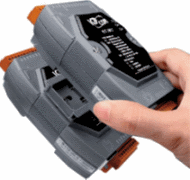
Interface modules from the I-7000 series by ICP DAS and ADAM-4000 series by Advantech are used. The main types of modules supported by ShR-ASDU are presented below.
| Model | Characteristics |
|---|---|
| Discrete DC Input Modules (Teleindication) | |
| I-7041D | 14 discrete input channels, with isolation up to 3750 V and indication (4…30 VDC) |
| I-7051D / ADAM-4051 | 16 discrete input channels, with isolation up to 3750 V and indication (10…50 VDC) |
| I-7052D / ADAM-4052 | 8 discrete input channels, with isolation up to 3750 V and indication (4…30 VDC) |
| I-7053D_FG / ADAM-4053 | 16 discrete input channels, with indication (4…30 VDC, dry contact) |
| Discrete AC Input Modules (Teleindication) | |
| I-7058D | 8 discrete AC input channels, with isolation up to 5000 V and indication (80…250 V) |
| I-7059D | 8 discrete AC input channels, with isolation up to 5000 V and indication (10…80 V) |
| Discrete DC Output Modules (Telecontrol) | |
| I-7042D | 13 discrete output channels, with isolation up to 3750 V and indication (10..30 V, up to 100 mA) |
| I-7045D | 16 discrete output channels, with isolation up to 3750 V and indication (MOSFET, 10..40 V, up to 650 mA) |
| I-7045D-NPN | 16 discrete output channels, with isolation up to 3750 V and indication (3.5..50 V, up to 700 mA) |
| Relay Output Modules (Telecontrol) | |
| I-7061D | 12 channels of high-power relay output, with isolation up to 3750 V and indication (electromechanical relay, 5A@250VAC) |
| Combined Input/Output Modules (Teleindication/Telecontrol) | |
| I-7050D | 7 discrete input channels / 8 discrete output channels (DI 10..30 V, 30 mA, DO 4…30 V) |
| I-7055D | 8 discrete input channels / 8 discrete output channels, with isolation up to 3750 V (DI 10..40 V, 650 mA, DO 10…50 V) |
| I-7063D | 3 channels of high-power relay output / 8 discrete input channels, with isolation up to 3750 V and indication (AX3, 5A@250VAC, 5A@30VDC), 8 DI (4..30 V) |
| I-7065D | 5 channels of high-power relay output / 4 discrete input channels, with isolation up to 3750 V |
| I-7063AD | 3 channels of solid-state relay output / 8 discrete input channels, with isolation up to 3750 V and indication (solid-state relays, normally open) |
| I-7065AD | 5 channels of solid-state relay output / 4 discrete input channels, with isolation up to 3750 V and indication (solid-state relays, normally open) |
| Thermocouple/Resistance Input Modules (Telemetry) | |
| I-7018BL / ADAM-4018 | 8 analog input or thermocouple signal channels: J. K. T. E. R. S.B. N. C. L. M |
| I-7013 / ADAM-4013 | 1 resistance temperature detector (RTD) signal input channel: Pt100, Pt1000, Ni120 |
| I-7015-G / ADAM-4015 | 6 resistance temperature detector (RTD) signal input channels: Pt100, Pt1000, Ni120, Ni100, Cu50, Cu100, Cu1000 |
| Analog Input Module (Telemetry) | |
| I-7012 / ADAM-4012 | 1 analog input channel / 1 discrete input channel / 2 discrete output channels |
| I-7012D / ADAM-4012 | 1 analog input channel / 1 discrete input channel / 2 discrete output channels, with indication |
| I-7017 / ADAM-4017 | 8 analog input channels (+/-150 mV, +/-500 mV, +/-1 V, +/-5 V, +/-10 V, +/-20 mA) |
| Analog Output Module (Telecontrol) | |
| I-7021 / ADAM-4021 | 1 analog output channel (0…10 V, 0..20 mA, 4…20 mA) |
| I-7024 | 4 analog output channels (0…10 V, +/-10 V, +/-5 V, 0..20 mA, 4…20 mA) |
* – support for other modules of the I-7000 and ADAM-4000 series is provided upon request. When ordering, it is necessary to specify the list of interface modules with which the ShR-ASDU is intended to be used.
** – the table lists the characteristics of I-7000 modules. Corresponding characteristics for ADAM-4000 modules may differ.
Factory Configuration
When ordering, it is recommended to specify the quantity and planned application scheme of interface modules and electricity meters for the purpose of performing factory configuration of ShR-ASDU. These measures will reduce the time for commissioning work and simplify its execution.
Below is the recommended form for providing data and an example of completion.
| RS-485 Port No. | Port Mode | Type of Connected Equipment | Quantity of Equipment of This Type |
|---|---|---|---|
| 1 | AMR | SET.4TM | 6 |
| 2 | AMR/ASDU | SET.4TM | 4 |
| 3 | TM | I-7061D | 6 |
| 4 | TM | I-7013 | 8 |
| … | … | … | … |